title: The machine, drawn date: 2026-09-15
The machine, drawn: the whole system from one config file
Click for full size. SVG version.
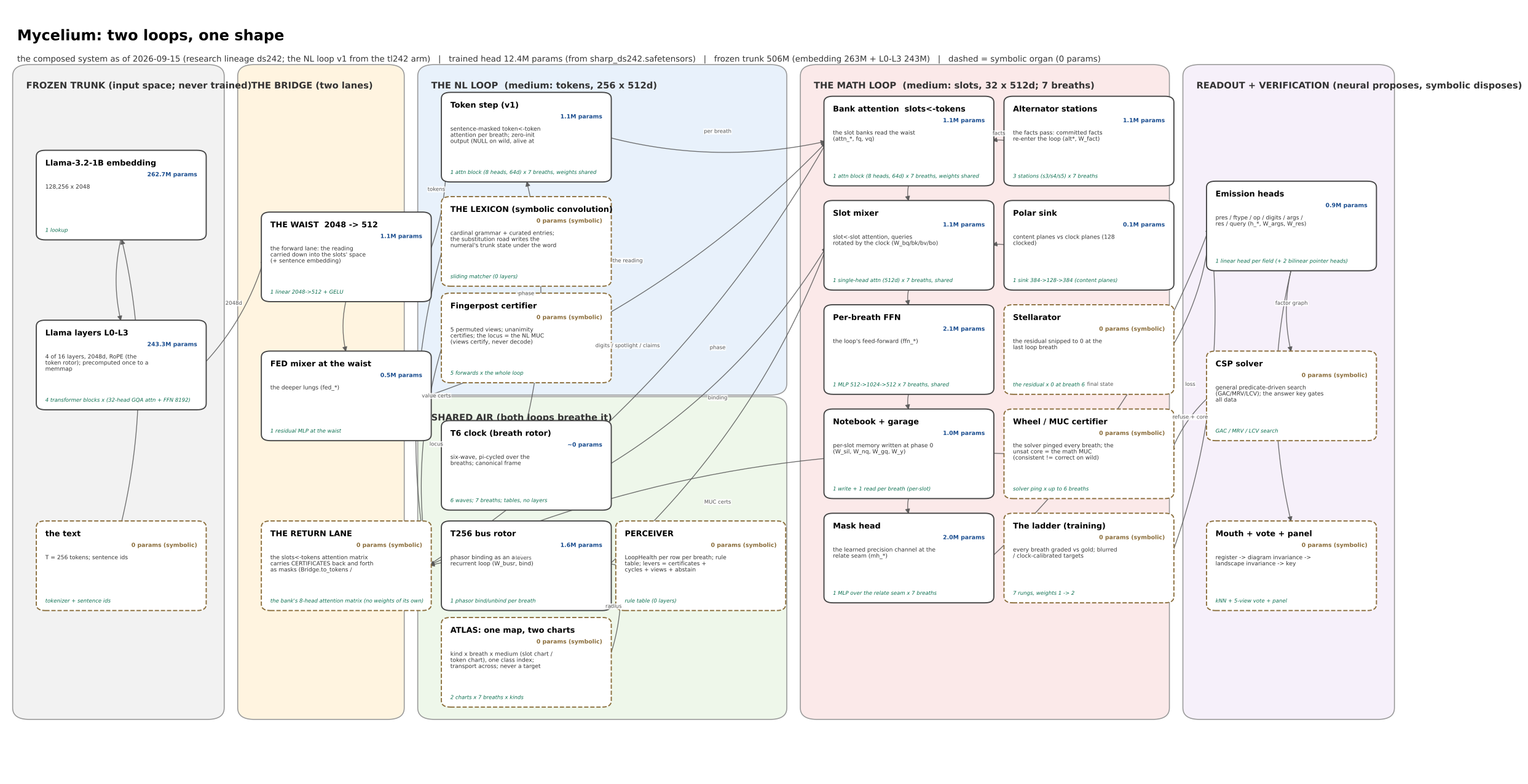
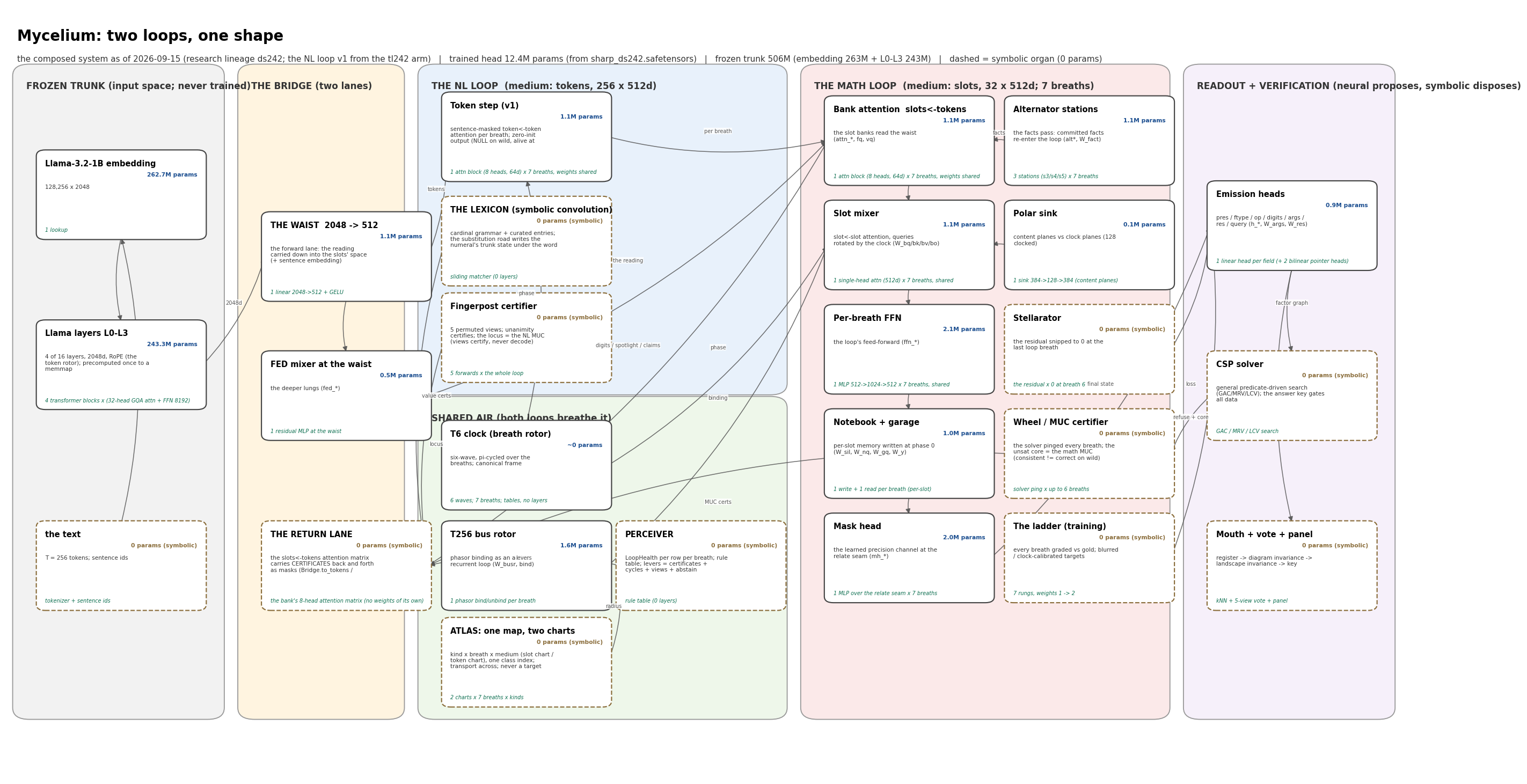
This is the composed system as of today, drawn by a script from a config file rather than by hand, so it can be redrawn whenever an organ is added, retired, or renamed. Every parameter count on the figure is counted from the checkpoint by matching the organ’s weight names, not typed: the trained head is 12.4M parameters in the research lineage, and the frozen trunk is 506M, of which 263M is the embedding and 243M is the four Llama layers we use of sixteen. Dashed boxes are symbolic organs with no parameters at all, which is most of the verification and all of the certifiers, the atlas, the bridge, the lexicon, and the perceiver.
How to read it
Left to right is the road a problem takes. The frozen trunk turns text into 2048-dimensional token features once, precomputed to disk. The bridge has two lanes: the waist carries the reading down to 512 dimensions where the slots live, and the return lane is the attention matrix itself, which carries certificates back and forth as masks. The two loops sit side by side. The language loop breathes on tokens, the math loop on slots, and both breathe the same air: the six-wave clock, the rotation bus, the atlas with its two charts, and the perceiver that watches them. The math loop is the larger machine, with the bank attention, the slot mixer, the per-breath feed-forward, the notebook and garage, the mask head, the alternator’s facts pass, the polar sink, and the stellarator’s residual snip. At the right, the emission heads read the final state into a factor graph, and the symbolic side disposes: the solver, the wheel’s unsat core, the mouth, the vote, and the answer key.
Rebuilding it
The description lives in docs/architecture.json: panels, organs with
a one-line detail and a rule for which weights belong to them, and the
edges. The tool is scripts/arch_diagram.py. It loads the checkpoint,
assigns every weight to exactly one organ, reports any weight it could
not place so the config can be completed, and writes the PNG and SVG.
When the next organ passes its bars, it gets a box and a regex, and the
figure is one command away.